Dr. Salama Idris Mustafa delivers an important lecture on supporting academic supervision through artificial intelligence at Alnoor University
Alnoor University held a distinguished academic event on Sunday, March 29, 2026, during which it hosted Associate Professor Dr. Salama Idris Mustafa Najm, a specialist in artificial intelligence and its advanced applications.
Dr. Salama obtained his bachelor’s degree in Computer Science from the University of Mosul in 2003, and later earned both his master’s degree (2012) and PhD (2016) in Information and Communication Technology from Universiti Tenaga Nasional (UNITEN) in Malaysia.
He previously served as a Head and Principal Investigator at the Center for Intelligent and Autonomous Systems (CIAS) at Universiti Tun Hussein Onn Malaysia (UTHM). He is currently a lecturer in the Department of Artificial Intelligence Engineering Technologies at the Technical Engineering College at Alnoor University. In addition, he serves as the Editor-in-Chief of the Journal of Soft Computing and Data Mining (JSCDM). He has also been selected among the top 2% of scientists worldwide for the years 2021–2025, according to the ranking by Stanford University and Elsevier.
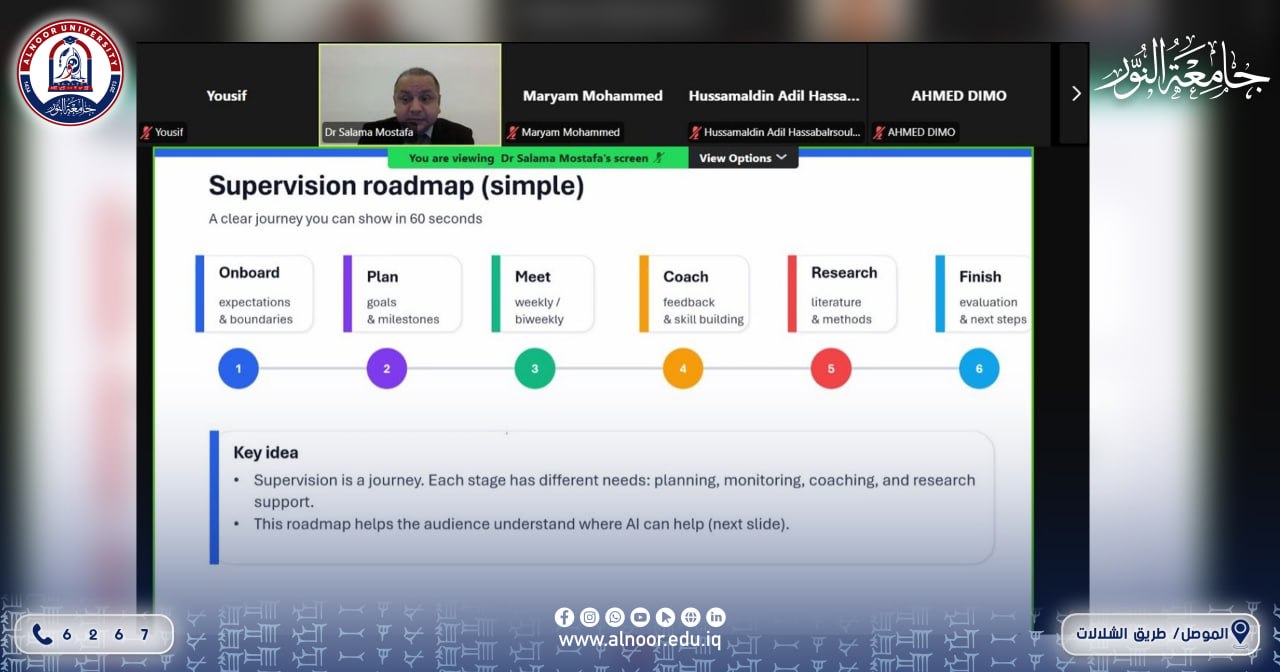
During the event titled (Artificial Intelligence for Supervision Support) Dr. Mustafa presented a simplified roadmap of research supervision, explaining the key stages a researcher goes through. These begin with the Onboarding stage, which involves setting expectations and boundaries, followed by the Planning stage to define goals and milestones. This is followed by regular Meetings, held weekly or biweekly, then the Coaching stage, which focuses on feedback and skill development. Next comes the Research stage, which includes literature review and methodology selection, and finally the Finish stage, which involves evaluation and identifying next steps.
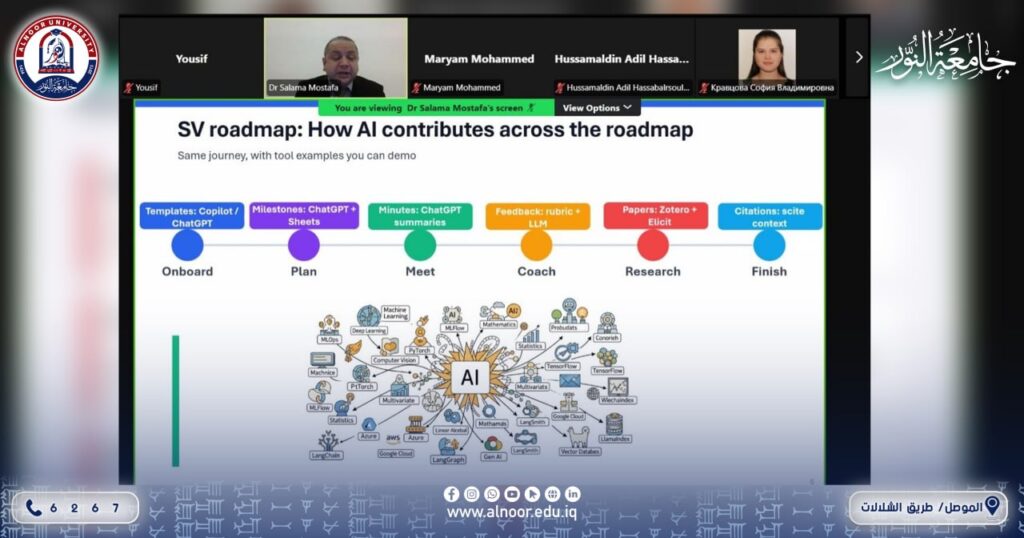
He outlined the role of the academic supervisor across the different stages of research, starting from defining the problem, the scope of the study, and ethical considerations, through developing the work plan and timelines, guiding the literature review, selecting methodologies and ensuring data quality, and finally reaching data analysis, writing up the research, and making publication decisions. In this context, he explained how artificial intelligence contributes to supporting academic supervision by assisting in formulating research questions, organizing plans, analyzing literature, designing research tools, processing data, and ultimately improving academic writing and preparing researchers for the defense and publication stages.
This hosting comes as part of the university’s efforts to enhance the research environment and to engage with distinguished academic expertise, contributing to the development of students’ capabilities and keeping pace with the rapid advancements in modern technology fields.